Most steam irons that stop working do not break because they are old. They break because of limescale, and whether your iron is at risk depends in large part on where you live. Around 60% of UK households are in a hard water area, which means the water you pour into the tank leaves mineral deposits behind every time it heats up. This guide explains what hard water is, shows which parts of the UK are affected, helps you spot the warning signs in your own iron, and sets out how to prevent the damage and what to do once it has happened.
What is hard water, and why does it matter for irons?
Hard water is simply water with a high level of dissolved minerals, mainly calcium and magnesium. It picks these up as rainwater filters through soft, porous rock such as chalk and limestone. The more minerals the water carries, the harder it is. Hardness is usually measured in milligrams of calcium carbonate per litre (mg/l), and many UK water companies still quote it in degrees Clark.
Your steam iron is unusually exposed to this. It heats water to boiling point again and again, and every time water turns to steam the minerals are left behind inside the appliance. Over months and years those deposits build up as limescale, the same chalky white residue you see in a kettle. In an iron, though, the scale collects in narrow channels and tiny steam holes, where even a small amount causes problems.
Hard water areas in the UK
Water hardness in the UK is almost entirely a question of local geology, so it varies sharply from region to region. As a rough guide, water is hardest across London, the South East and the East of England, where it flows through chalk and limestone. It is softest across Scotland, Wales, the North West and parts of the South West, where the underlying rock is harder and less soluble. The table below shows the general pattern.
| Region | Typical hardness | Classification | What it means for your iron |
| London & South East | 250 to 350+ mg/l | Hard to very hard | Highest limescale risk; frequent descaling needed |
| East of England | 200 to 350 mg/l | Hard to very hard | Chalk and limestone geology means heavy scale build-up |
| Midlands | 150 to 300 mg/l | Moderately hard to hard | Varies by supplier; regular descaling advisable |
| South West England | 60 to 250 mg/l | Soft to hard (varies) | Mixed; Bath and some areas are very hard |
| Wales | 50 to 200 mg/l | Soft to moderately hard | Mostly soft, with some harder pockets |
| North West (inc. Liverpool & Manchester) | Under 100 mg/l | Soft | Low limescale risk |
| Scotland | Under 75 mg/l | Soft | Minimal scaling in most areas |
Figures are indicative regional ranges based on water company data and are measured as calcium carbonate (mg/l). Hardness can vary by postcode, so confirm your own level with your water supplier.
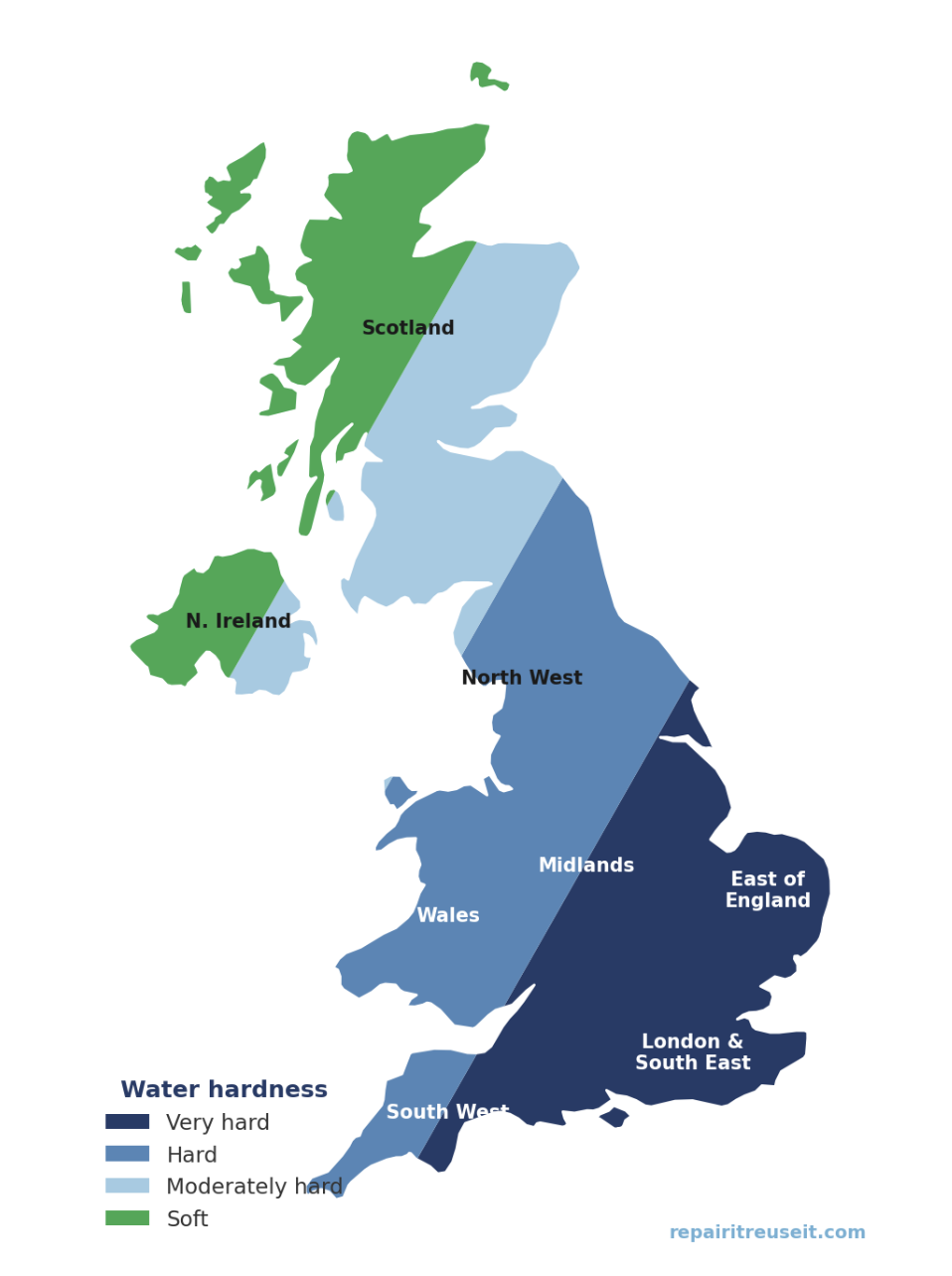
These are broad regional patterns, and your exact level can differ from one street to the next because supplies are sometimes blended. The only reliable way to know your figure is to check your postcode with your water supplier, most of which publish a hardness lookup on their website. As a benchmark, water under about 60 mg/l is considered soft, anything above roughly 200 mg/l is hard, and very hard water exceeds 300 mg/l.
How limescale damages a steam iron
Limescale does not damage an iron all at once. It builds up quietly until performance drops or a fault appears. These are the main ways it does its damage.
Blocked steam vents and soleplate holes
Scale collects around the small holes in the soleplate and the steam channels behind them. As the holes narrow, steam output falls, so the iron glides across fabric but no longer presses creases out properly. Left long enough, the steam can stop altogether.
Clogged internal channels, leaking and spitting
Deposits also gather in the iron’s internal tubes and, in steam generator models, the pump and boiler. When scale partially blocks these, water is forced through unevenly. The result is an iron that leaks or spits water and hot droplets onto your clothes instead of producing a clean, even steam.
White and brown marks on fabric
As scale loosens it can be pushed out through the soleplate during use. That shows up as white flakes or gritty deposits, or as brown spotting where mineral residue has baked on inside the iron. Either way, it transfers onto the very clothes you are trying to press.
These are not unusual faults. Loss of steam, water leakage and heating problems are among the most common issues we see come into our workshop, and in hard water areas limescale is very often the cause.
The best water to use in a steam iron
This is the question we are asked most, and the answer is less obvious than it used to be. In a hard water area, filling your iron straight from the tap speeds up scale build-up considerably. Using cooled, previously boiled water or filtered water lowers the mineral content and slows the process down.
It is tempting to assume pure distilled or de-ionised water is the safest choice, but for many modern irons it is not recommended on its own. Some manufacturers design their irons to work best with ordinary tap water, while others suggest a mix of tap and distilled water rather than distilled alone. Always check the manual for your specific model, because the wrong water can in some cases affect the anti-scale system or void the warranty.
How to prevent limescale damage
You cannot change your water supply, but a few simple habits make a real difference, especially in harder areas.
- Use the self-clean or anti-calc function regularly. Most irons have one, and running it flushes loose scale out before it can block anything.
- Empty the tank after every use. Leaving water sitting in the iron gives minerals time to settle and harden.
- Descale to a schedule that matches your water. In a very hard area you may need to descale every few weeks; in a soft area, far less often.
- Use the right water for your model, as set out above.
It is worth knowing that “anti-scale” and “anti-calc” features, which appear on many popular models including much of the Tefal Pro Express range, reduce scale build-up but do not remove the need for maintenance. They slow the problem rather than solve it, so regular care still matters.
When prevention is not enough: Repair, do not replace
If your iron has already lost steam, started leaking or stopped heating, limescale damage does not have to mean buying a new one. Scrapping a faulty appliance sends it to landfill and costs far more than a repair. We have already saved more than 100,000 appliances from being thrown away, and a limescale related fault is usually a straightforward fix.
Our steam iron repair service covers all the major brands, including Tefal and Rowenta. We fix 99% of the steam irons we receive, every repair is backed by a 90 day warranty, and we collect and return across the UK, so you do not need to leave home. If your iron is showing any of the signs above, you can request a repair quote and our engineers will take a look.
Frequently asked questions
Does using bottled water stop limescale in a steam iron?
Not necessarily. Many bottled mineral waters contain high levels of calcium and magnesium, so they can scale an iron just as quickly as hard tap water. Filtered or cooled boiled water is usually a better choice, but always follow your manufacturer’s guidance.
How often should I descale my iron in a hard water area?
There is no single answer, because it depends on how hard your water is and how often you iron. As a rule of thumb, the harder your water and the heavier your use, the more often you should run the self-clean or descaling cycle. Monthly is a sensible starting point in hard areas.
Can a steam iron be repaired once limescale has damaged it?
In most cases, yes. Blocked steam systems, leaks and heating faults caused by scale are common and usually repairable. It is almost always cheaper, and far better for the environment, than replacing the iron.