Most coffee machines that stop working do not fail because they are old. They fail because of limescale, and whether your machine is at risk depends largely on where you live. Around 60% of UK households are in a hard water area, which means the water going into your coffee machine leaves mineral deposits behind every time it heats up.
Over time, those deposits build up inside pumps, heating systems, valves and brewing units, reducing performance and eventually causing faults. This guide explains what hard water is, shows which parts of the UK are most affected, helps you identify the warning signs in your own machine, and outlines what you can do to prevent damage before it leads to an expensive repair or replacement.
Whether you own a Sage Barista Express, De’Longhi Magnifica, Krups Evidence, Siemens EQ Series or another bean-to-cup coffee machine, understanding the impact of hard water can help you keep it running properly for years to come.
What is hard water, and why does it matter for coffee machines?
Hard water is simply water that contains high levels of dissolved minerals, primarily calcium and magnesium. These minerals are picked up naturally as rainwater passes through porous rocks such as chalk and limestone before entering the water supply.
Water hardness is usually measured in milligrams of calcium carbonate per litre (mg/l). The higher the concentration of minerals, the harder the water.
Coffee machines are particularly vulnerable to hard water because they heat water repeatedly under pressure. Every time water is heated, a small amount of mineral residue is left behind. Over weeks, months and years, this residue hardens into limescale.
Unlike a kettle, where limescale is often visible, most coffee machine scale develops deep inside the appliance. It accumulates in narrow pipes, thermoblocks, pumps, solenoid valves and brewing systems where it gradually restricts water flow and affects performance.
Bean-to-cup and espresso machines are especially sensitive because they rely on precise temperatures and pressures to produce consistent coffee. Even a small amount of scale can affect extraction quality, steam performance and brewing times.
This is one of the most common issues we encounter in our workshop. Many machines that arrive with water flow problems, weak coffee output or steam faults are suffering from limescale build-up rather than a major mechanical failure.
Hard water areas in the UK
Water hardness across the UK is largely determined by local geology, which means it varies significantly depending on where you live.
As a general rule, water is hardest across London, the South East and the East of England, where supplies pass through chalk and limestone formations. It is generally softer across Scotland, Wales, the North West and parts of the South West.
The table below provides an overview of typical hardness levels and what they may mean for your coffee machine.
| Region | Typical Hardness | Classification | What It Means for Your Coffee Machine |
| London & South East | 250 to 350+ mg/l | Hard to very hard | Highest limescale risk, frequent descaling required |
| East of England | 200 to 350 mg/l | Hard to very hard | Heavy scale build-up likely |
| Midlands | 150 to 300 mg/l | Moderately hard to hard | Regular maintenance advisable |
| South West England | 60 to 250 mg/l | Soft to hard (varies) | Scale risk varies significantly |
| Wales | 50 to 200 mg/l | Soft to moderately hard | Generally lower limescale levels |
| North West (including Liverpool & Manchester) | Under 100 mg/l | Soft | Lower limescale risk |
| Scotland | Under 75 mg/l | Soft | Minimal scaling in most areas |
Figures are indicative regional ranges based on water company data and are measured as calcium carbonate (mg/l). Hardness can vary by postcode, so check directly with your water supplier for accurate local information.
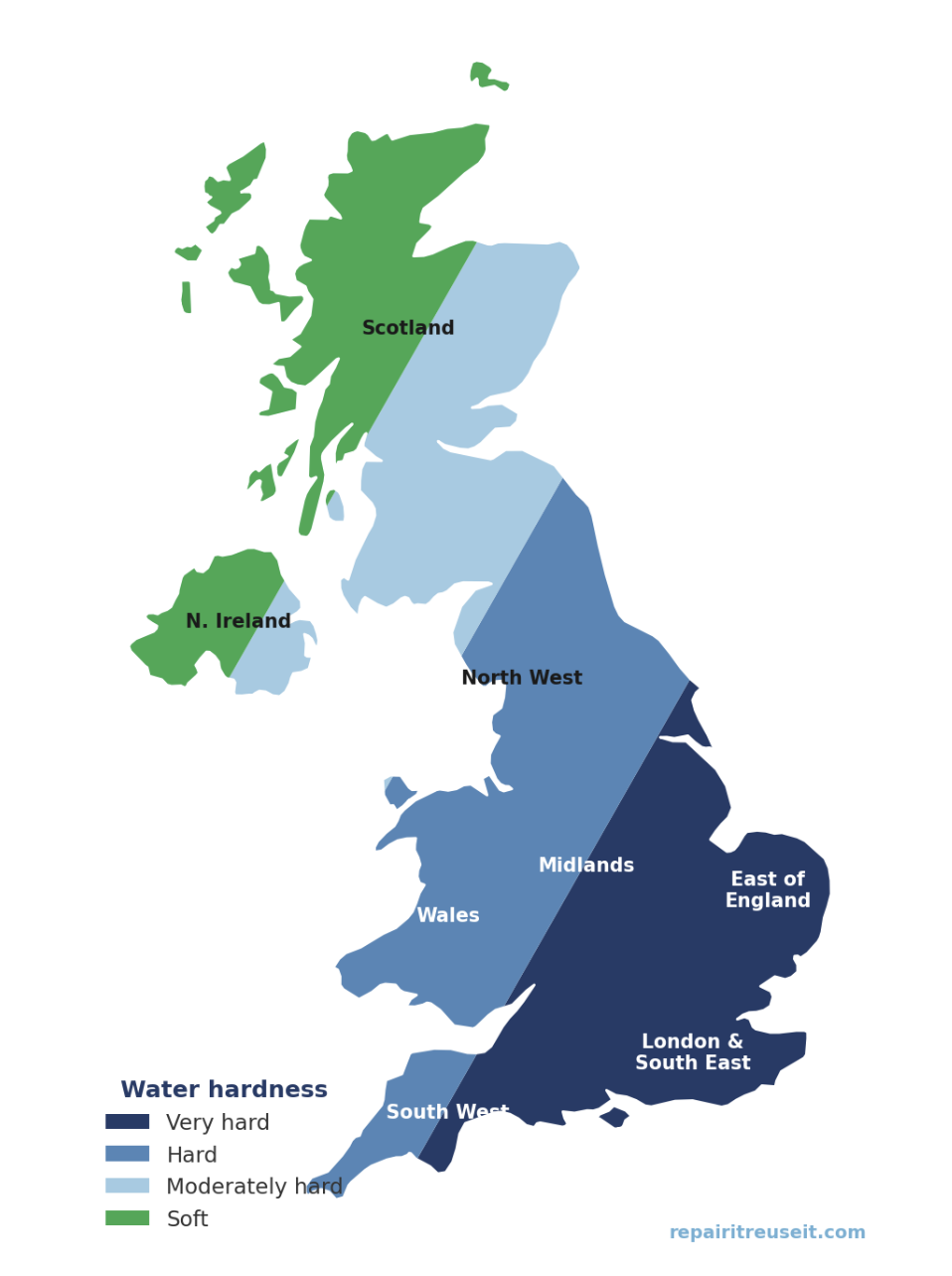
As a guide, water under 60 mg/l is generally considered soft, while anything above 200 mg/l is considered hard. Very hard water typically exceeds 300 mg/l.
How limescale damages a coffee machine
Limescale rarely causes an immediate failure. Instead, it develops gradually until performance deteriorates or a fault appears.
Blocked internal water lines
Coffee machines rely on narrow internal pipes to move water through the brewing system. As scale accumulates, these passages become restricted. The result can be slower dispensing, reduced water flow, longer brewing times or incomplete brewing cycles. If left untreated, severe blockages can eventually prevent water from reaching key components altogether.
Pump and boiler problems
Limescale also affects pumps, thermoblocks and boilers. As scale narrows internal pathways, the pump must work harder to force water through the machine. This increases wear and places additional strain on internal components. Over time, pressure levels become inconsistent, leading to weaker espresso shots, reduced steam performance and unreliable operation.
Poor coffee taste and extraction
One of the first signs of limescale is often a decline in coffee quality. Coffee machines are designed to operate within specific temperature ranges. When scale forms on heating elements and thermoblocks, temperature control becomes less accurate. This can result in:
- Weak coffee
- Bitter coffee
- Under-extracted espresso
- Inconsistent flavour
- Reduced crema quality
Many users assume their coffee beans are the problem when the real cause is hidden limescale inside the machine.
Steam wand performance issues
For machines with milk frothing systems, limescale often affects steam production. Steam pressure may become weaker, milk may take longer to heat, or the steam wand may stop functioning altogether. This is particularly common on heavily used bean-to-cup and espresso machines.
Error messages and machine shutdowns
Modern coffee machines contain sensors designed to detect abnormal water flow and operating conditions.
As scale builds up, you may begin to see:
- Descale warnings
- Water circuit errors
- Flow meter faults
- Heating errors
- Brewing interruptions
- Automatic shutdowns
We regularly see these symptoms on popular models from Sage, De’Longhi, Krups, Siemens, Jura and Philips.
The best water to use in a coffee machine
This is one of the most common questions we receive from coffee machine owners. In hard water areas, filling your machine directly from the tap can significantly increase limescale build-up. Filtered water can help reduce mineral levels and slow the rate at which scale forms.
However, the answer is not always straightforward. Many people assume distilled or de-ionised water is the ideal solution. In reality, many manufacturers advise against using pure distilled water on its own. Some machines rely on mineral content to accurately detect water levels and monitor brewing conditions. Completely removing minerals can sometimes affect sensors and machine performance.
Water also plays an important role in flavour. Coffee brewed with completely demineralised water can taste flat compared with coffee brewed using water containing balanced mineral levels.
For this reason, manufacturers such as Sage, Jura and De’Longhi typically recommend either filtered tap water or approved water filtration systems rather than pure distilled water. Always check your machine’s manual before changing water types, as recommendations vary by manufacturer and model.
How to prevent limescale damage
You cannot change your local water supply, but a few simple habits can dramatically reduce the risk of limescale-related problems.
- Run descaling cycles as recommended by the manufacturer.
- Use integrated water filters where available.
- Replace filter cartridges on schedule.
- Configure your machine’s water hardness setting correctly.
- Complete automatic cleaning programmes when prompted.
- Avoid ignoring descale warnings.
- Empty water tanks if the machine will not be used for extended periods.
As a rough guide:
- Very hard water areas: descale every 1 to 2 months
- Moderately hard areas: descale every 2 to 3 months
- Soft water areas: descale every 4 to 6 months
Many modern machines include anti-scale technologies, but these systems reduce scale build-up rather than eliminate it. Regular maintenance is still essential. For additional maintenance advice, see our guide to why a coffee machine is not dispensing water.
When prevention is not enough: repair, don’t replace
If your coffee machine has already developed water flow issues, steam faults, heating problems or brewing errors, limescale damage does not necessarily mean the machine needs replacing. Many scale-related faults are entirely repairable.
At Repair It Reuse It, we repair coffee machines from all major manufacturers, including Sage, Krups, De’Longhi, Siemens, Philips and Jura. Our engineers regularly dismantle, clean and restore machines affected by severe limescale build-up.
Repairing rather than replacing is often significantly cheaper and prevents otherwise repairable appliances from ending up in landfill.
We have already helped save more than 100,000 appliances from being discarded unnecessarily. Every repair is backed by a 90-day warranty, and our nationwide collection and return service means you can arrange a repair without leaving home.
If your machine is dispensing slowly, producing poor coffee, struggling to generate steam or displaying recurring error messages, our coffee machine repair service may be able to help.
Frequently asked questions
Does hard water damage coffee machines?
Yes. Hard water causes limescale to form inside coffee machines over time. This can restrict water flow, affect brewing temperatures, reduce steam performance and eventually lead to component failure.
How often should I descale my coffee machine?
This depends on your local water hardness and how frequently you use the machine. In hard water areas, every one to two months is often appropriate, while soft water areas may only require descaling every four to six months.
Is filtered water better for coffee machines?
In many cases, yes. Filtered water reduces mineral content and slows limescale build-up while retaining enough minerals to support good coffee flavour.
Can a coffee machine be repaired after limescale damage?
Most limescale-related faults can be repaired. Blocked systems, poor water flow, steam issues and heating problems are among the most common coffee machine repairs we undertake.
Why is my coffee machine dispensing slowly?
A common cause is limescale restricting water flow through internal pipes and valves. However, filters, pumps and brewing components can also contribute to slow dispensing.
Does bottled water prevent limescale?
Not necessarily. Many bottled waters contain significant mineral content and can still cause limescale build-up. Always check the mineral analysis and follow manufacturer guidance.